
You are here: Academic / Seniors / Curriculum / Music
At PGHS Music is taught through listening, performing and composing (with an emphasis on practical music making). Students study a wide range of music. They perform songs and instrumental pieces as a class and in groups and regularly compose. All students get first hand experience of using music technology throughout the course with the Music Department’s own dedicated ICT suite.
The Music Department consists of 2 academic teaching staff and 7 peripatetic teaching staff. The Headmistress also shares in the extra-curricular teaching. Most of the teaching takes place in a dedicated music classroom and 2 instrumental teaching rooms. The music room includes its own ICT suite (software includes Sibelius, Cubase, Reason), an interactive whiteboard as well as a wide range of instruments including 15 electronic keyboards. The School hall is used for concerts and rehearsing, and some local venues are regularly used such as St. John’s Church and “The Intimate Theatre”. All students from Year 7 to Year 9 receive specialist music tuition. GCSE take up is above the national average and a third of students taking GCSE over the last 5 years have gone on to take A level.
Students learn to use the sequencer programme ‘Cubase’.
Introductory Topic ‘The Elements of Music’ – Students become familiar with the basic building blocks of all music and are introduced to music theory.
Topic 1 ‘Melody’ - Students learn what features make a satisfying melody. Concepts learnt include, ‘question and answer’ phrases, melodic form and graphic notation.
Topic 2 ‘The Music of Java and Bali’ - Students learn to appreciate some of the features of Gamelan music such as cyclic and interlocking melodies and textural layers. This topic also includes a trip to the LSO Educational Centre where students take part in a workshop playing a real gamelan.
Topic 3 ‘Major and Minor’ - Students gain an understanding of the difference between major and minor. Concepts covered include major and minor scales, and the rhythms of the Tango and Habanera. Students also encounter the work of Bizet, Bach and Ives.
Topic 4 ‘Working With Chords’ - Students develop an awareness of texture, harmony and chordal relationships. Concepts covered include primary chords, chord symbols, passing notes and harmonic series. Students also encounter the work of Monteverdi, Berlioz and the Beetles.
Students continue using the sequencer programme ‘Cubase’ and also learn to use the virtual studio recording and producing software programme ‘Reason’.
Introductory Topic – Students develop their singing technique, learn about triads and improve their knowledge of theory.
Topic 1 ‘Chords’ - Students learn how to construct a melody from a chord sequence and become familiar with some of the features of 1950’s popular music.
Topic 2 ‘Using Chords in Songs’ - Students enhance their knowledge of chords and of chord sequences.
Topic 3 ‘Using Reason’ – Students learn basic recording studio techniques using the virtual software ‘Reason’
Topic 4 ‘Rondos and Recurring Structures’ – Students comprehend the basic structure of rondo form.
Students carry on developing their understanding of music theory and continue composing using Cubase and Reason. They are also introduced to Sibelius music software.
Topic 1 ‘5 and 7 Time’ - Students study regular and irregular rhythms and unusual time signatures.
Topic 2 ‘Ground Bass Variations’ -Students are introduced to this large-scale form and compositional technique.
Topic 3 ‘Vocal Chants’ –Students study the musical potential of the voice with particular reference to the work of Taverner.
Topic 4 ‘Music and Media’ – Students study how music is used in Advertisements, Cartoons and Films and compose music for each genre.
Topic 5 ‘Samba’ – Students are introduced to Latin American music.
Students prepare for the Edexcel GCSE Examination which is taken at the end of Year 11. The three aspects of performing, composing and listening are related to each other through four Areas of Study.
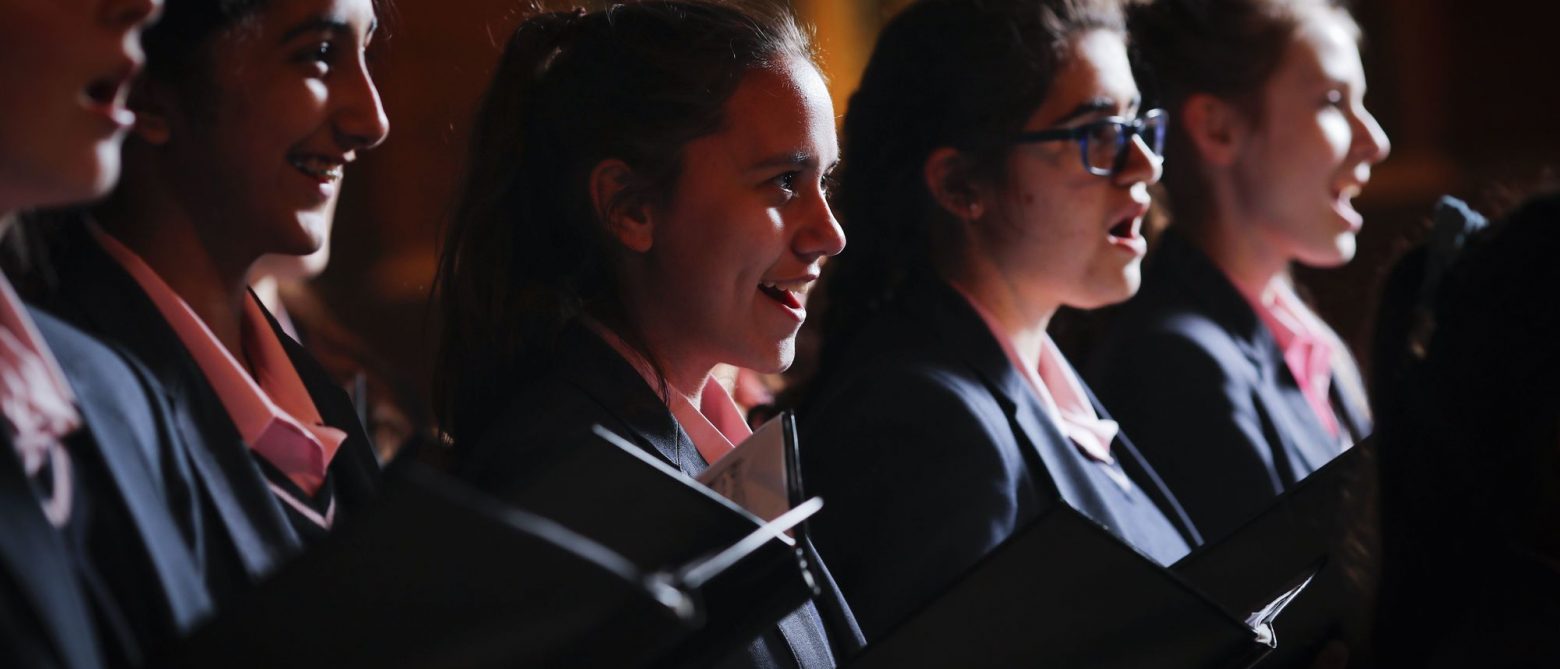
Choral Concert Yellow House
Structure in Western classical music 1600 - 1899, Changing directions in Western classical music from 1900, Popular music in context, Indian raga, African music and fusions.
Solo Performing, Ensemble Performing Composition 1, Composition 2, Listening and Appraising.
The Music Department offers a range of activities that the girls can become involved in such as Senior Orchestra, Senior Choir, Chamber Choir, The Band as well as Flute Choir, String Ensemble and Clarinet Ensemble.
In 2011, music Students at PGHS achieved 100% pass rate at A*/A grades.
Left menu